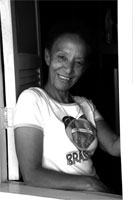
Portraits - Sebastiana Célia de Oliveira
Is a single 62 year old lady, born in Ipameri/GO. Sebastiana’s parents died when she was still a little girl. From that time until when she was eight years old, she lived in an orphanage in Ipameri. Adopted at this time, she was taken to Itapira, inner São Paulo, and later to Pindamonhangaba, in the same state.
Until she was 23 years of age, she led a normal life. Her adoptive mother wasn’t concerned when, once, Sebastiana complained about a strong pain in her leg . As the pain worsened, Sebastiana was taken to many doctors, all of whom testified that the pain was psychological. As a result, every time she felt the pain in her leg, she was taken to a psychiatric hospital.
After being repeatedly admitted into different psychiatric hospitals, Sebastiana was taken to Barbacena in 1970, where she remained confined for 30 consecutive years.
She arrived at the hospital and at night, as she awoke, she heard a frightening noise: “I felt so scared that I was as white as a sheet. I was electrocuted and I took anatensol. I have a compassionate spirit, I’m a catholic and I survived because of my faith and the church. I vowed that, if my teeth went bad, I would survive for five years like that, suffering. The good teeth broke and became rotten. I felt ashamed of myself, I was disfigured, ugly. Once, they gave me a torn dress. As I was trying to fix the dress, I tried to cut it, and they thought that I was tearing the cloth. They electrocuted me as a form to punish me.”
After years of suffering, the hospital underwent a reform
and the “better” women went to a new building.
“I also went along. The surroundings improved and
I started taking care of myself. I would help with the
cleaning, do manual labor, so I became friends with
the domestic helpers. I even went to Mobral, and took
part in occupational therapy. I started doing nails and
earn money. I began to treat my teeth with the money I
earned. I always thought of leaving that place. I would
write many letters to my family, although it was hard
to post them.”
In these 30 years, she was visited by her family members only twice.
Finally, in November 2000, she was discharged from the hospital and went to the first therapeutic residence of the county along with patients of other psychiatric institutions.
During this time, she started going to school. She studied until the third grade. She had a boyfriend, but then she ended the relationship when she thought that it wouldn’t work out. She spent her free time with religious activities. On December 2004, she chose to live alone, even though she had a good relationship with her housemates.
In August 2005, she was hired by the José Luiz Ferreira institute, an organization that worked in association with the mental health project of the health department. She was now a co-worker of the other health professionals that worked at the residences. Sebastiana was hired as the caretaker of the housemates of other therapeutic residences in activities such as walks, trips, social events, doctor’s appointments etc. She has been doing well, building social ties along the way, some of which were impossible to have during the years of segregation while at the hospital.
"What I most like, honestly, is my freedom to do as I wish. To feel God close to me, in nature. I like to walk on the streets... I said that one day it would end, and it did. I’m happy, very happy.”
Sebastiana, like the meaning of her name in portuguese, is worthy of respect. With a frank and sincere smile, Sebastiana overleapt the walls and flourished.
 Previous portrait